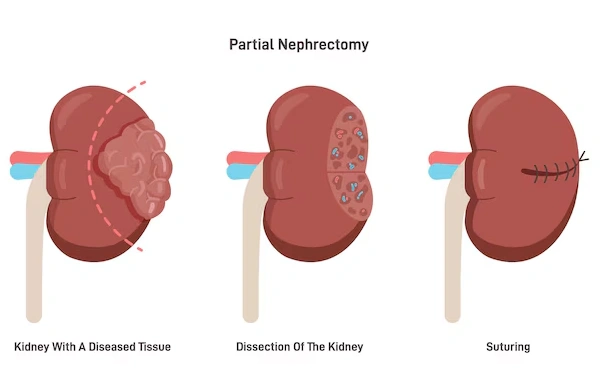
Partial nephrectomy is a surgical procedure performed to remove only the diseased or tumor-affected portion of the kidney while preserving the healthy kidney tissue. This procedure is commonly recommended for patients with small kidney tumors or localized kidney disease. By preserving as much healthy kidney tissue as possible, partial nephrectomy helps maintain normal kidney function. For advanced surgical care, many patients seek Partial Nephrectomy treatment in Mumbai under the expertise of Dr. Shashank Sharma, a highly experienced Consultant Urologist specializing in kidney surgeries and minimally invasive urological procedures.
Partial nephrectomy, also known as kidney-sparing surgery, is a procedure in which only the tumor or diseased part of the kidney is removed while the rest of the kidney remains intact.
This surgery is often recommended for small kidney tumors, benign growths, or localized kidney diseases. Preserving healthy kidney tissue is important because it helps maintain proper kidney function and reduces the risk of kidney failure in the future.
Partial nephrectomy can be performed using open surgery, laparoscopic surgery, or robotic-assisted techniques, depending on the size and location of the tumor.
Partial nephrectomy is recommended when it is possible to remove the diseased portion of the kidney while preserving healthy tissue.
Small Kidney Tumors:
Tumors smaller than 4 cm are often treated using partial nephrectomy.
Early-Stage Kidney Cancer:
Removing only the tumor can effectively treat localized kidney cancer.
Benign Kidney Growths:
Non-cancerous kidney masses may require surgical removal.
Single Functional Kidney:
Preserving kidney tissue is especially important for patients who have only one functioning kidney.
Risk of Kidney Function Loss:
Kidney-sparing surgery helps maintain long-term kidney function.
Genetic Kidney Conditions:
Some inherited conditions cause multiple kidney tumors that require tissue preservation.
Partial nephrectomy is an important treatment option for protecting kidney health while effectively treating disease.
Preserves Kidney Function:
Only the affected portion is removed, allowing the remaining kidney tissue to function normally.
Effective Cancer Treatment:
Removes localized tumors while maintaining organ function.
Reduces Risk of Kidney Failure:
Preserving kidney tissue helps prevent long-term kidney complications.
Minimally Invasive Options:
Modern laparoscopic and robotic techniques allow faster recovery.
Lower Risk of Chronic Kidney Disease:
Maintaining kidney tissue helps protect long-term health.
Improved Quality of Life:
Patients retain better kidney function after treatment.
The approach to Partial Nephrectomy treatment in Mumbai depends on the size, location, and complexity of the kidney tumor. Dr. Shashank Sharma performs this surgery using advanced techniques to ensure safe and effective outcomes.
Before recommending partial nephrectomy, doctors perform a detailed evaluation to understand the condition of the kidney and the tumor.
Diagnostic tests may include:
CT scan or MRI to determine tumor size and location
Ultrasound imaging of the kidney
Blood tests to evaluate kidney function
Urine tests to detect abnormalities
Biopsy in some cases to confirm diagnosis
Partial nephrectomy is usually performed under general anesthesia.
There are several surgical approaches:
Laparoscopic Partial Nephrectomy:
Small incisions are made in the abdomen, and camera-guided instruments are used to remove the tumor.
Robotic-Assisted Surgery:
Advanced robotic technology allows precise tumor removal while preserving healthy tissue.
Open Partial Nephrectomy:
In some complex cases, a larger incision may be required.
During the procedure:
The surgeon carefully exposes the kidney.
Blood supply to the kidney may be temporarily controlled to reduce bleeding.
The tumor or diseased portion of the kidney is carefully removed.
The remaining kidney tissue is repaired and preserved.
The incision is closed using sutures.
The surgery typically takes 2 to 3 hours, depending on the complexity of the case.
Recovery after partial nephrectomy depends on the surgical technique used.
Patients who undergo laparoscopic or robotic surgery usually recover faster and may stay in the hospital for 2–3 days.
After surgery, patients are generally advised to:
Avoid heavy lifting and strenuous activities for several weeks
Maintain proper hydration to support kidney function
Follow a balanced diet for overall health
Take prescribed medications for pain and infection prevention
Attend regular follow-up visits to monitor kidney function
Most patients can return to normal daily activities within 3–6 weeks.
Partial nephrectomy provides several advantages compared to complete kidney removal.
Kidney-Sparing Surgery:
Preserves healthy kidney tissue and maintains function.
Effective Tumor Removal:
Successfully treats small and localized kidney tumors.
Lower Risk of Kidney Failure:
Maintaining kidney tissue helps prevent long-term complications.
Minimally Invasive Options Available:
Laparoscopic and robotic techniques offer faster recovery.
Better Long-Term Health Outcomes:
Patients retain better kidney function over time.
Improved Quality of Life:
Most patients recover well and maintain normal kidney activity.
Highly Experienced Urologist:
Dr. Shashank Sharma has over 12 years of experience in performing advanced kidney surgeries.
Expert in Kidney-Sparing Surgery:
Specializes in partial nephrectomy, radical nephrectomy, and minimally invasive kidney procedures.
Advanced Surgical Technology:
Uses modern laparoscopic and robotic techniques for precise treatment.
Personalized Treatment Plans:
Each patient receives customized care based on their medical condition.
Focus on Organ Preservation:
Prioritizes techniques that preserve kidney function whenever possible.
Comprehensive Follow-up Care:
Ensures long-term monitoring and kidney health management.
Partial nephrectomy removes only the tumor or diseased portion of the kidney, while radical nephrectomy removes the entire kidney and surrounding tissues.
Yes, it is considered a safe and effective surgery, especially for treating small kidney tumors while preserving kidney function.
Most patients recover within 3–6 weeks, depending on the surgical approach and overall health.
In most cases, kidney function remains stable because the healthy portion of the kidney is preserved.
As with any surgery, there are risks such as bleeding or infection, but these are minimized when the procedure is performed by an experienced surgeon.


Comments
Be the first to review