
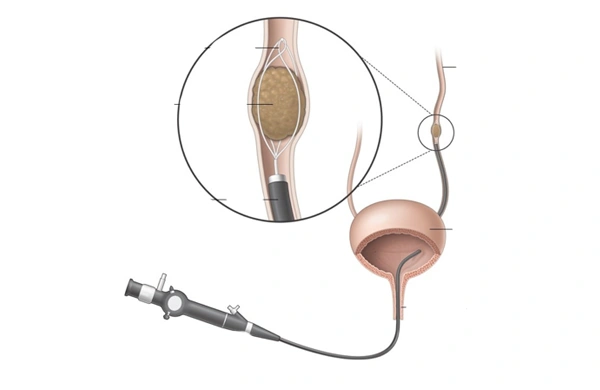
Ureteroscopy is a minimally invasive procedure used to diagnose and treat problems in the ureter and kidney, including kidney stones, blockages, or abnormal growths. The ureter is the tube that carries urine from the kidney to the bladder. When stones or other issues occur in this passage, ureteroscopy allows doctors to directly view and treat the condition using a thin, specialized instrument called a ureteroscope. For advanced and effective care, many patients seek Ureteroscopy treatment in Mumbai under the expertise of Dr. Shashank Sharma, a highly experienced Consultant Urologist specializing in modern endoscopic and laser-based urological procedures.
Ureteroscopy is an endoscopic procedure that allows a doctor to examine the ureter and kidney using a thin, flexible or rigid instrument known as a ureteroscope.
The ureteroscope is inserted through the natural urinary passage—urethra, bladder, and then into the ureter—without making any surgical incision. This instrument has a tiny camera and light source that enables the doctor to see the urinary tract clearly on a monitor.
If stones or abnormalities are found, the doctor can use specialized tools or laser technology to break or remove the stones during the same procedure.
Ureteroscopy is recommended when there are problems in the ureter or kidney that require direct examination or treatment.
Kidney or Ureter Stones:
It is commonly used to locate and remove stones that cause severe pain or blockage.
Urinary Obstruction:
Stones or strictures can block the flow of urine from the kidney to the bladder.
Persistent Pain:
Patients experiencing severe flank or abdominal pain may require ureteroscopy for diagnosis and treatment.
Blood in Urine:
The procedure helps identify the cause of unexplained bleeding in the urinary tract.
Narrowing of the Ureter (Stricture):
Ureteroscopy helps detect and sometimes treat ureteral strictures.
Abnormal Growths:
Doctors can detect tumors or abnormal tissue inside the ureter or kidney.
Ureteroscopy plays an important role in diagnosing and treating urinary tract conditions effectively.
Accurate Diagnosis:
Provides a clear view of the ureter and kidney for precise diagnosis.
Effective Stone Treatment:
Allows direct removal or fragmentation of stones.
Minimally Invasive Approach:
The procedure does not require any external incisions.
Early Detection of Problems:
Helps identify tumors, strictures, and other abnormalities early.
Restores Urinary Flow:
Removing stones or blockages improves urine drainage.
Improves Patient Comfort:
Treating the root cause reduces pain and urinary symptoms.
The approach to Ureteroscopy treatment in Mumbai depends on the patient’s condition and the size or location of the stone or abnormality. Dr. Shashank Sharma performs ureteroscopy using advanced endoscopic instruments and modern technology for accurate diagnosis and treatment.
Before performing ureteroscopy, doctors may recommend certain tests to evaluate the urinary tract.
Ultrasound of the kidneys and urinary system
CT scan to determine stone size and location
X-ray imaging if required
Urine tests to detect infection
Blood tests to assess kidney function
Ureteroscopy is usually performed under general or spinal anesthesia to ensure patient comfort.
A thin ureteroscope is inserted through the urethra and bladder into the ureter.
The doctor locates the stone or abnormal area using the camera attached to the instrument.
If a stone is present, laser energy may be used to break it into smaller fragments.
Small fragments may be removed using specialized instruments or allowed to pass naturally through urine.
In some cases, a temporary ureteral stent may be placed to ensure proper urine flow and healing.
The procedure typically takes 30 to 60 minutes, depending on the complexity of the case.
Recovery after ureteroscopy is usually quick because it is a minimally invasive procedure.
Most patients can return home within 24 hours. Mild symptoms such as burning during urination, slight blood in urine, or mild discomfort may occur for a short time after the procedure.
Patients are generally advised to:
Drink plenty of water to flush the urinary system
Take prescribed medications to prevent infection
Avoid heavy physical activity for a few days
Attend follow-up visits to ensure proper healing
If a ureteral stent is placed, it is usually removed after 1–2 weeks.
Ureteroscopy offers several advantages in diagnosing and treating ureter and kidney conditions.
Minimally Invasive Procedure:
No surgical incisions are required.
High Success Rate:
Effective for treating ureteric and kidney stones.
Direct Visualization:
Provides a clear view of the urinary tract.
Short Hospital Stay:
Most patients are discharged within a day.
Faster Recovery:
Patients can resume normal activities quickly.
Safe and Effective Treatment:
Modern technology ensures precise and safe procedures.
Experienced Urologist:
Dr. Shashank Sharma has over 12 years of experience in advanced urological procedures.
Expertise in Endoscopic Stone Surgery:
Specializes in ureteroscopy, URSL, RIRS, PCNL, and laser lithotripsy.
Advanced Medical Technology:
Uses modern endoscopic equipment and laser systems for accurate treatment.
Minimally Invasive Approach:
Focuses on treatments that reduce pain and ensure faster recovery.
Personalized Treatment Plans:
Provides customized care based on each patient’s condition.
Comprehensive Follow-up Care:
Ensures long-term urinary health and prevention of stone recurrence.
Yes, ureteroscopy is a safe and minimally invasive procedure widely used to diagnose and treat urinary tract problems.
The procedure usually takes 30 to 60 minutes, depending on the complexity of the condition.
Most ureteroscopy procedures are done as day-care procedures, and patients can go home within 24 hours.
In some cases, a temporary ureteral stent may be placed to help urine flow and aid healing.
Most patients recover within a few days, although mild urinary symptoms may occur temporarily.



Comments
Be the first to review